
5 步走 [pytorch]
- opt zero
- forward
- loss
- backward
- opt step
1for batch_idx, (data, _) in enumerate(train_loader):2 data = data.to(device)3 optimizer_vae.zero_grad()4 recon_batch, mu, logvar = vae(data)5 loss = vae_loss(recon_batch, data, mu, logvar)6 loss.backward()7 optimizer_vae.step()💡 Discussion: VAE
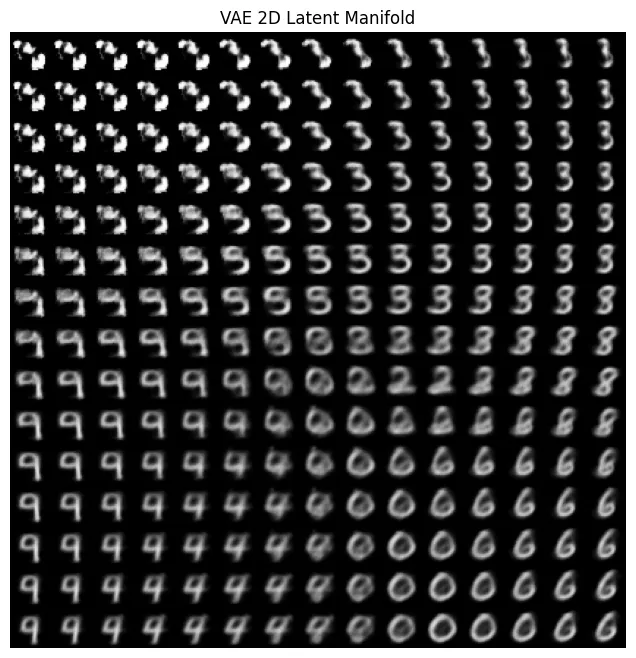
Question 1: Why do the generated digits from the VAE look somewhat blurry compared to real MNIST images?
特征在数字特征之间了
Question 2: What would happen if we remove the KL-divergence term from the loss?
让我试试. 生成了非常糟糕的结果
💡 Discussion: GAN
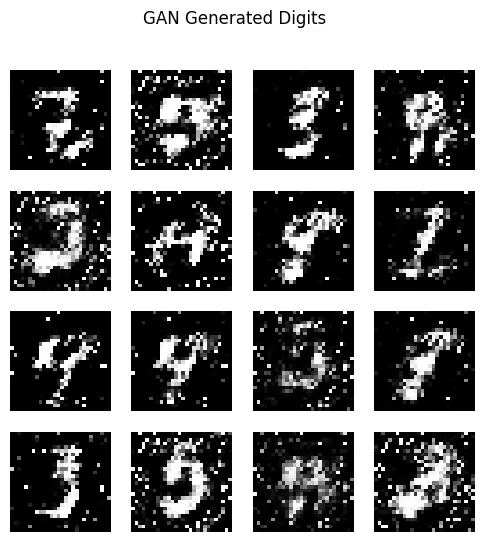
Question 1: Why do GANs generate sharper images than VAEs?
因为对抗损失过度逼近高频细节 而 VAE 用了 KL,如果高频细节过多,KL 损失就大
Question 2: What is “Mode Collapse”? (You might even observe it in your output grid)
只学会了其中集中样式。因为判别器也不判多样性。
💡 Discussion: Diffusion Models
Question 1: What exactly does num_inference_steps do?
调节生成单步走多少
Question 2: What is guidance_scale (Classifier-Free Guidance / CFG)?
就是对 prompt 的权重(放大条件信号) Classifier-Free 的原理:每步做两个预测,uncond 和 prompt-conditioned,然后 diffusion 走的方向取个加权. Use-classifer 方法:用分类器梯度引导
- (\epsilon_{\text{guided}}):引导后的噪声预测,用它来做反向采样更新。
- (\epsilon_\theta(x_t,t)):扩散模型(参数为 (\theta))在时间步 (t) 对当前噪声图 (x_t) 的原始噪声预测。
- (x_t):第 (t) 步的带噪图像(latent/像素都可,看模型定义)。
- (t):扩散时间步。
- (s):guidance strength / scale,引导强度超参数。
- (\sigma_t):与时间步 (t) 对应的噪声尺度(由噪声调度器决定)。
- (\nabla_{x_t}):对 (x_t) 求梯度。
- (\log p_\phi(y|x_t,t)):分类器(参数 (\phi))在给定 (x_t,t) 时,对目标类别 (y) 的对数概率。
- (p_\phi(y|x_t,t)):分类器输出的类别后验概率。
- (y):你希望生成结果符合的目标类别标签。
- (\phi):外部分类器参数。
- (\theta):扩散模型参数。
1# x_t: [B, C, H, W]2# t: [B] or scalar timestep3# y: [B] target class ids4# s: guidance scale (float)5# sigma_t: noise scale at timestep t (float or tensor broadcastable to x_t)6
7x_t = x_t.detach().requires_grad_(True)8
9# 扩散模型给原始噪声预测10with torch.no_grad():11 eps = unet(x_t, t) # epsilon_theta(x_t, t)12
13# 3) 外部分类器给类别分数(需要梯度)14logits = classifier(x_t, t) # [B, num_classes]15log_probs = F.log_softmax(logits, dim=-1)11 collapsed lines
16# 每个样本目标类log p17selected = log_probs[torch.arange(x_t.size(0), device=x_t.device), y]18obj = selected.sum() # 标量,便于 autograd19
20# 4) 求 grad = ∇_{x_t} log p(y|x_t,t)21grad = torch.autograd.grad(obj, x_t, only_inputs=True)[0]22eps_guided = eps - s * sigma_t * grad23with torch.no_grad():24 x_prev = ddpm_step(x_t.detach(), eps_guided.detach(), t)25
26x_t = x_prev