
RT-2 (1)
⭐️⭐️⭐️ 利用 VLM 直接输出离散动作
和 OpenVLA 同属一派,将 VLM 的最后 256 个 token id 分配给动作,直接将 x, y, z, yaw, pitch, roll, gripper 划分为 256 个离散桶 (token id),七个动作维度共享 token id 并通过位置区分语义,直接拼接丢给 VLM 输出隐状态,一个 head 解码出 token id 再映射回动作空间. 缺点是离散化和自回归导致的精度不够.
RT-1 输出的同样为离散词表,只不过是从零开始训练小型 transformer.
TODO: 数据集这一块儿有空可以再看看.
World Model for Robot Learning: A Comprehensive Survey (2)
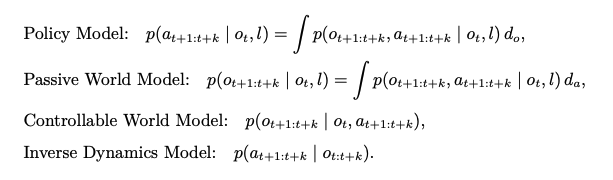
Fast-WAM (Yuanet al., 2026) (3)
可被视为该家族中的一个混合点:它采用具有共享注意力的 Transformer 混合体骨干网络 及耦合的视频与动作分支,但结论认为主要优势可能更多来自训练期间的视频协同训练,而非推理阶段 的显式未来想象。在这些变体中,视频分支越来越不再被视为需要忠实渲染的输出,而是被看作一种预 测性潜在过程,其隐状态用于指导动作生成. (by 综述)
不论在 train-time 还是 infer-time, noisy action 都只会 attend 第一帧视频的 kv. infer-time 只需要把 clean obs_image 丢进 dit 前向跑一次生成 kv 给 action 用.
可以解释为,train-time 联合训练多帧视频和动作生成的好处是逼着 video z_0 编码能够“从当前画面推导出未来变化”的信息。Fast-wam 没有历史信息.
video loss: 让 z0 表征更懂未来/动力学
action loss: 让 action expert 学会从这个 z0 表征里采样动作
所谓双 DiT,其实就是 MoT,即 video DiT 和 action DiT 在每个 transformer layer 通过 self-attention 双向注意.
Lingbot-va (4)
- https://hjfy.top/arxiv/2601.21998 Lin Li, Yinghao Xu
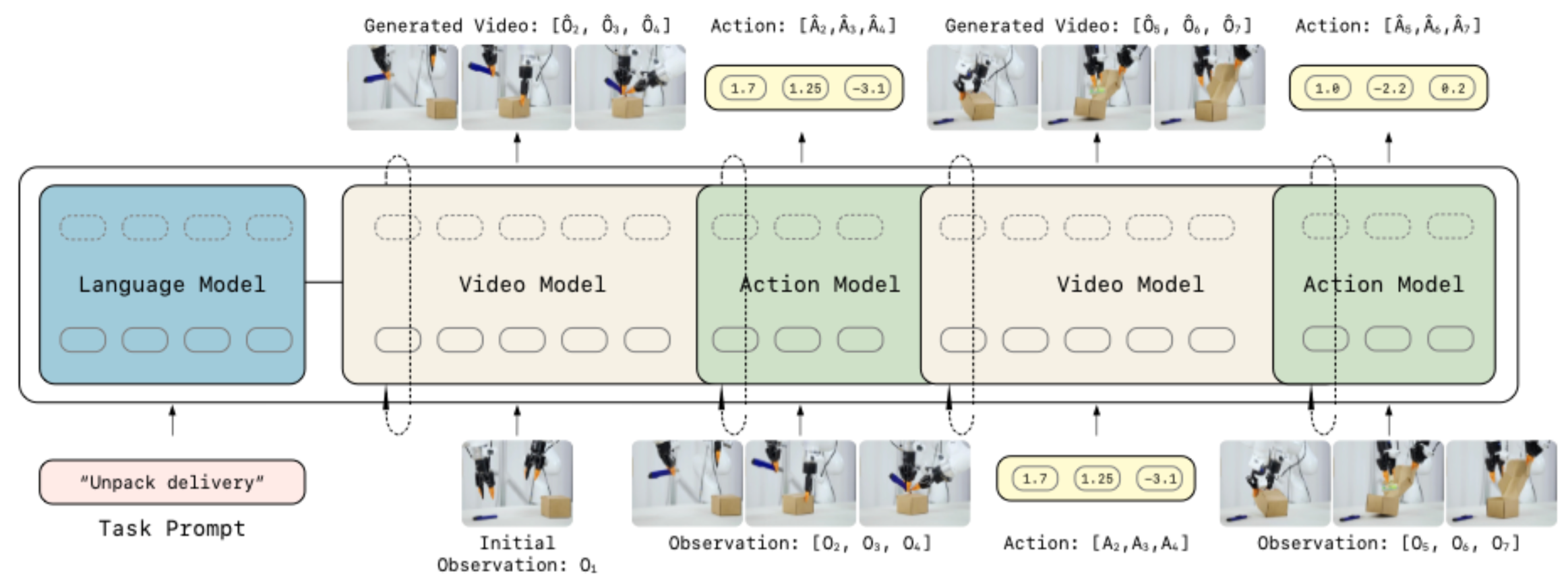
lingbot-va 的自回归扩散方法为:video/action diffusion 后对 clean token 计算 kv 存入 kv cache,此后 DiT 每一层将会 attend 之前的 kv. 而 diffusion 顺序为 video 2 帧 -> action 2x16 帧(这部分相当于 IDM) -> video 2 帧 -> action 2x16 帧,所有动作均会执行.
默认实现为 shared backbone,通过 action_mode 分支区分 video input 和 action input,它会选择不同的 input embedder, time embedder 和 output head. KV cache 使用 ring buffer 维护,容量约 9792 tokens.
1obs0 -> VAE -> z02
3infer #1 (frame_st_id=0):41) flow denoise video chunk [z0_anchor, z1_hat] # 2帧5 - 第0帧 init_latent=z06 - 第1帧才是预测的未来 latent72) flow denoise action chunk [a_grp0(16步), a_grp1(16步)] # 1 action chunk = 2 group(对齐 2 video frame) = 32 steps8 - 条件:cache(空) + 刚预测的 video chunk9
10execute #1(第一轮特殊):11 start_idx=1 -> 跳过 a_grp0,只执行 a_grp1 的 16 步12 每 4 步收一次 obs -> key_frame_list(约 4 个真实 obs)13
14compute_kv_cache #1:15 clear_pred_cache() # 删掉 z_hat、a_hat,不是“替换某几帧”18 collapsed lines
16 real_z = VAE(key_frame_list)17 若 frame_st_id==0: cat(init_latent=z0, real_z)18 real_a = preprocess(executed action chunk)19 写入 cache(is_pred=False)20
21---22
23infer #2:24 预测下一个 chunk [z2_hat, z3_hat] + [a_grp2, a_grp3]25 条件:cache 里的 real history26
27execute #2 起:28 start_idx=0 -> 执行所有 32 步 action29 每 4 步收 obs -> key_frame_list(约 8 个)30
31compute_kv_cache #2:32 再次 clear_pred_cache()33 追加新的 real_z / real_a(real_a != pred_a)RTC (5)
- https://arxiv.org/abs/2506.07339 | Kevin Black, Sergey

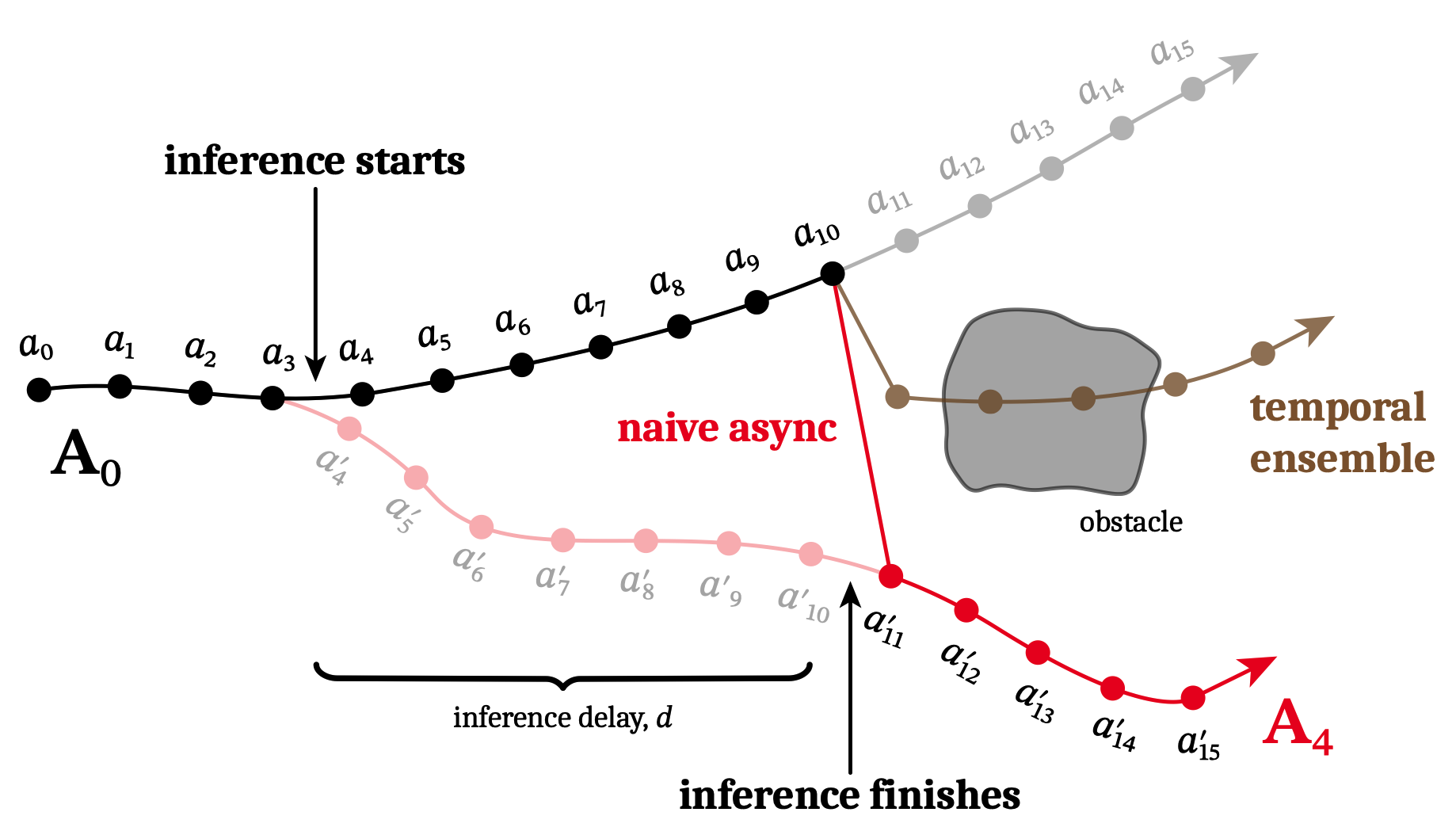
考虑上面图的问题:前后两个 chunk 重合处不能完美一致,所以 naive async 几乎必然会抖动. 从图中 a11 开始插值(平滑地增加权重)是一个可行方案,但是这会导致插值段之后和之前缺乏关联. RTC 同样从 a11 开始使用平滑权重,只不过直接 guidance 原本的 action expert FM 过程:
1# 符号:H: (Prediction Horizon), M: 动作维度 (Action Dim), O: 观测维度2def rtc_inference(v_net, o_t, A_prev, d, s, n=5, beta=5):3 """4 变量:o_t: 观测 [O], A_prev: 旧动作块的残余部分 [H, M] (已 pad0 至H长度)5 d: 推理延迟 s: 执行步长 n: 迭代步数 beta: 引导项裁剪值6 """7
8 A_tau = torch.randn((H, M)) # [H, M] 采样初始噪声9 W = compute_soft_mask(d, s, H) # [H, 1] 软掩码权重,1 ~ 0递减10 for tau in np.linspace(0, 1, n):11 v = v_net(A_tau, o_t, tau) # [H, M] 当前速度场预测12 A_hat_1 = A_tau + (1 - tau) * v # [H, M] 无 guidance 情况下的最终动作13 loss = 0.5 * (W * (A_prev - A_hat_1)**2).sum() # 标量14 g = torch.autograd.grad(loss, A_tau)[0] # [H, M] 获取修正梯度,指引 A_tau 向 A_prev 靠拢15 scale = min(beta, get_weight_scale(tau)) # get_weight_scale 是一个随 tau 递减的权重2 collapsed lines
16 A_tau += (1/n) * (v + scale * g) # [H, M] 结合原始预测与裁剪后的引导项进行更新17 return A_tau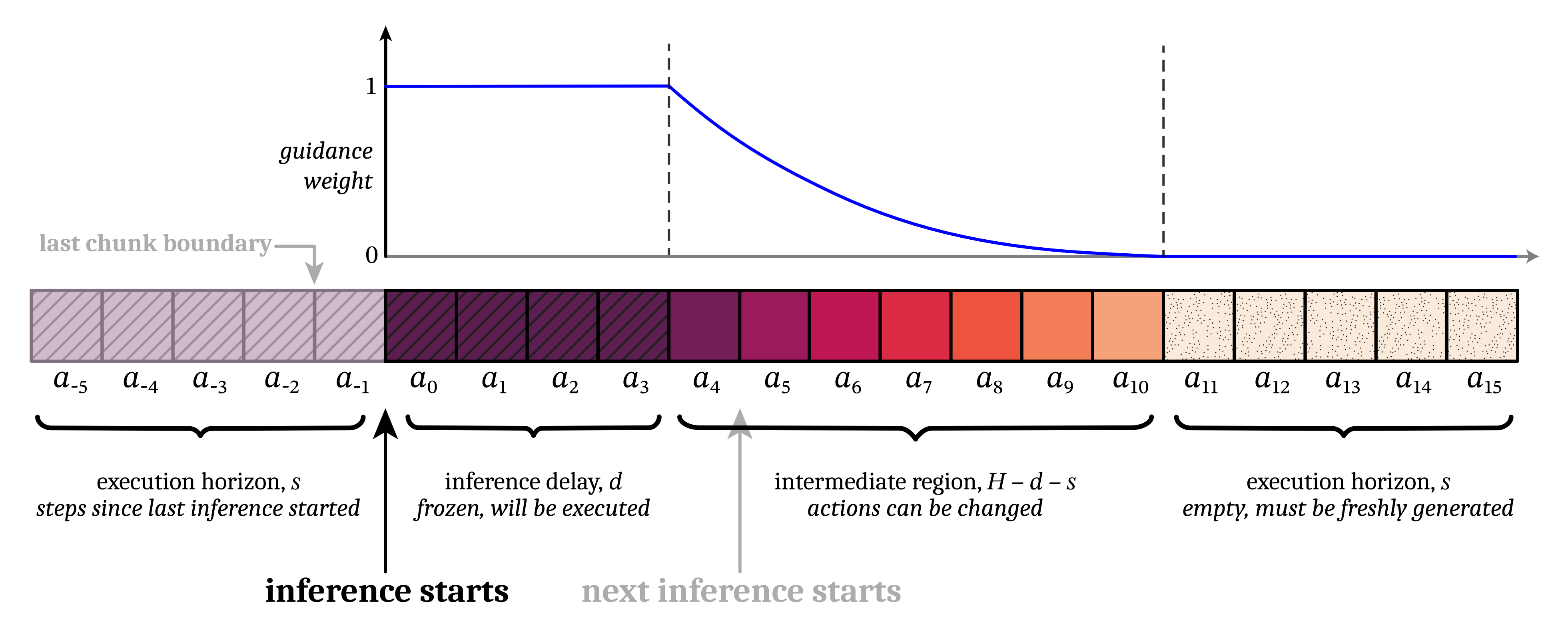
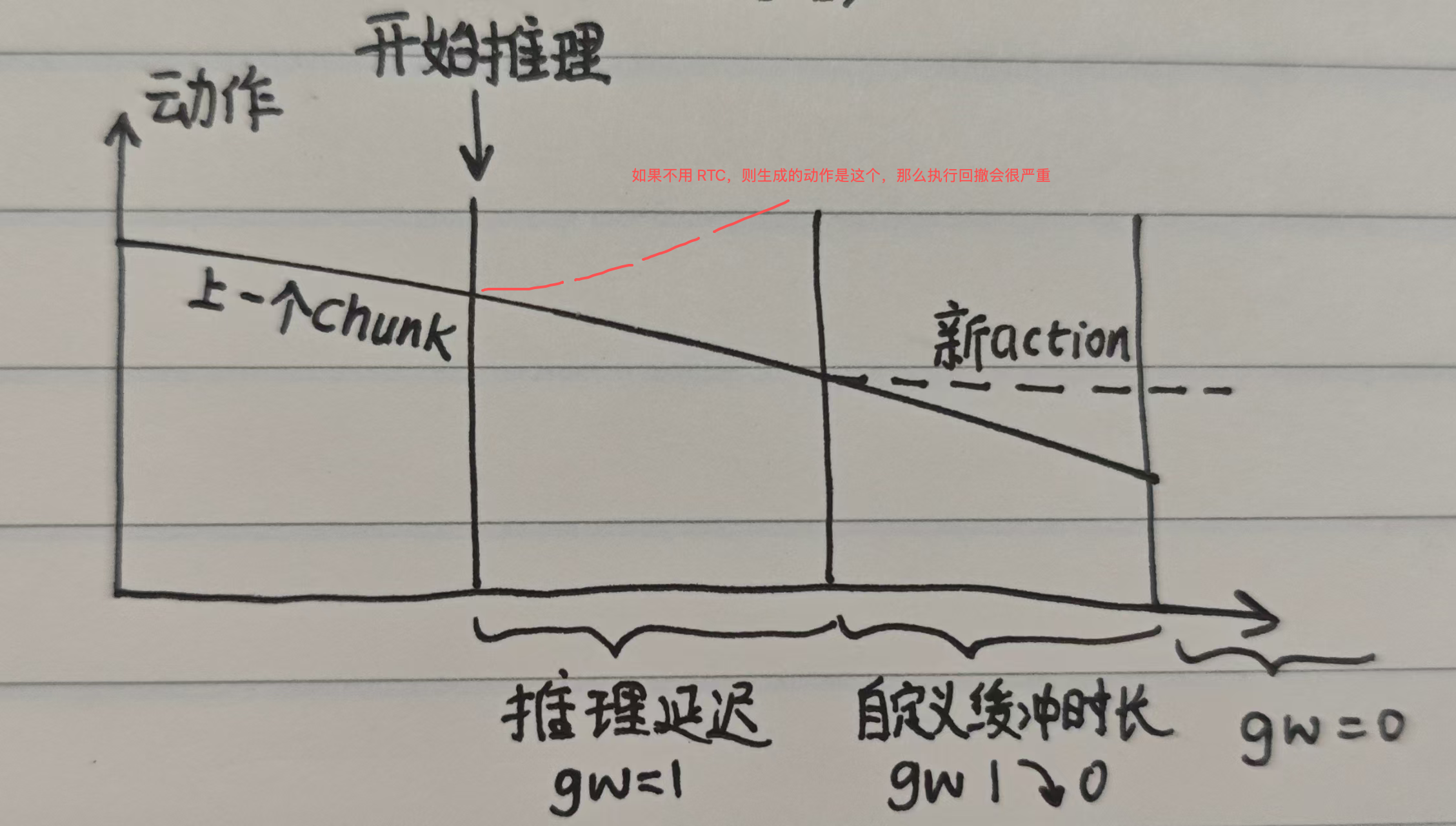
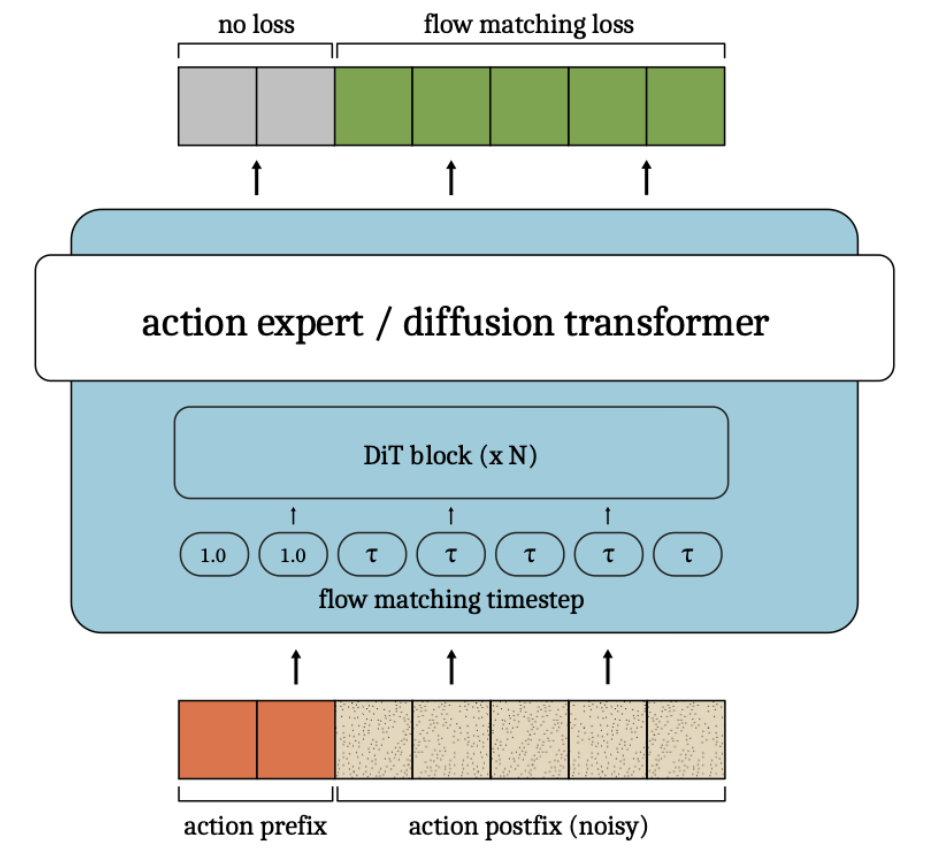
随后提出了 Train-time RTC https://hjfy.top/arxiv/2512.05964 。既然开始推理时刻需要基于上一个 chunk 的后缀进行 autograd inpainting,干脆直接在训练时让模型以上一个 chunk 的后缀(直接用 clean GT action)作为条件直接去噪,从而大幅节省 infer-time autograd 开销。由于不知道 infer-time 的真实 delay,训练时采用 randomly sampled delay.
Pi0.6 & Pi0.5 & Pi0 (6,7,8)
Pi0 除了以下设计,还引入了 zero-padding 进行跨本体混合训练,即状态和动作向量长度设定为数据集中最大自由度,不足补 0. 模型只能通过输入的本体感知 (例如 is_pad 信息?)和语言指令来识别当前的硬件构型. Pi0 并不能 zero-shot,但预训练能够帮助后训练的性能提升. 其他博主的一些理解:
Pi0 分离 actor 和 VLM,是为了避免后训练中对 VLM 能力的灾难性破坏.
Pi0 一次性引入了多个在后续被广泛使用的 Setting,当然,这些内容一开始的出处在这里不作考证,包括使用 MoT 进行 LLM 以及 Actor 的交互(见 Bagel ↗︎),使用 Flow Matching Loss 训练 Actor 以及使用 zero-padding 来进行跨本地的混合训练。
flowchart TD
    img["Images
(B, n_cam=3, H=224, W=224, C=3)"] --> siglip["PaliGemma Image Encoder(SigLIP)"]
    txt["Text Tokens
(B, max_token_len=48)"] --> tok["Gemma Token Embedding"]
    siglip --> vis["Visual Tokens
(B, 3*256=768, D=2048)"]
    tok --> textemb["Text Embeddings
(B, 48, D=2048)"]
    vis --> prefix["Prefix Tokens
(B, seq_len=816, D=2048)"]
    textemb --> prefix
    state["Robot State
(B, action_dim=32)"] --> stateproj["state_proj"]
    noisy["Noisy Actions x_t
(B, horizon=50, action_dim=32)"] --> actproj["action_in_proj"]
    time["Flow Time t
(B,)"] --> timemlp["Time Embedding MLP"]
    stateproj --> statetok["State Token
(B, 1, D=1024)"]
    actproj --> acttok["Action Tokens
(B, 50, D=1024)"]
    timemlp --> timetok["Time Tokens
(B, 50, D=1024)"]
    acttok --> mix["Action + Time Tokens
(B, 50, D=1024)"]
    timetok --> mix
    statetok --> suffix["Suffix Tokens
(B, seq_len=51, D=1024)"]
    mix --> suffix
    prefix --> pg["PaliGemma / Gemma 2B Expert"]
    suffix --> ae["Action Expert / Gemma 300M"]
    pg <--> shared["Shared Masked Self-Attn (qkv dim=256)"]
    ae <--> shared
    shared --> actout["action_out_proj"]
    actout --> vt["Predicted v_t
(B, 50, action_dim=32)"]
    gt["Target u_t = noise - action
(B, 50, action_dim=32)"] --> loss["Flow Matching Loss"]
    vt --> loss
其中一个 layer 的伪代码:
1obs = norm_obs(obs0) # (B, Lo, 2048)2act = norm_act(act0) # (B, La, 1024)3q_obs = Wq_obs(obs).view(B, Lo, 8, 256).transpose(1, 2) # (B, 8, Lo, 256)4k_obs = Wk_obs(obs).view(B, Lo, 1, 256).transpose(1, 2) # (B, 1, Lo, 256)5v_obs = Wv_obs(obs).view(B, Lo, 1, 256).transpose(1, 2) # (B, 1, Lo, 256)6q_act = Wq_act(act).view(B, La, 8, 256).transpose(1, 2) # (B, 8, La, 256)7k_act = Wk_act(act).view(B, La, 1, 256).transpose(1, 2) # (B, 1, La, 256)8v_act = Wv_act(act).view(B, La, 1, 256).transpose(1, 2) # (B, 1, La, 256), Wv_act(act) is (B, La, 256)9
10q = cat([q_obs, q_act], dim=2) # (B, 8, Lo+La, 256)11k = repeat_kv(cat([k_obs, k_act], dim=2), n_rep=8) # (B, 8, Lo+La, 256)12v = repeat_kv(cat([v_obs, v_act], dim=2), n_rep=8) # (B, 8, Lo+La, 256)13
14y = softmax(q @ k.transpose(-2, -1)) @ v # (B, 8, Lo+La, 256)15y = y.transpose(1, 2).reshape(B, Lo+La, 2048) # (B, Lo+La, 2048)5 collapsed lines
16
17obs_y = Wo_obs(y[:, :Lo]) # (B, Lo, 2048)18act_y = Wo_act(y[:, Lo:]) # (B, La, 1024)19obs1 = gated_residual(obs0, obs_y) # (B, Lo, 2048)20act1 = gated_residual(act0, act_y) # (B, La, 1024)Pi0.5
https://arxiv.org/abs/2504.16054
一句话:对 state 进行 bin 离散并以文本丢进 VLM,预训练则对 action 使用 FAST[1] 分词器离散从而在不启用 action expert 的情况下进行 LLM-like NTP 预测并使用交叉熵 loss. 目的是大幅加快训练,而 infer-time 用 flow matching 反而更快。然而,对于跨本体 state 似乎没有做特殊处理,而都是归一化,可能需要通过语言指令来识别本体。
架构新技巧:
- pi0.5 flow time t 使用 adaRMSNorm[2] 用作 action flow condition. (pi0 是 MLP 直接为 token , concat action token)
- pi0.5 将 state 离散化为 task prompt(在 pi0 中,state 是过 linear 进 action expert)
- 另外预训练/后训练有一种 KI 做法:AE 的梯度不传回 VLM 防止损害,而 VLM 通过 next-token-predict 离散 action 来学习动作表征.
- FAST tokenizer 就是先将整个 action chunk (原文说了是 compressing the action chunks) 先 encode 为 8 个 latent 然后 vector quantize 就完事. 最终将 50x19 action 转为 8 个 token.
- adarmsnorm: 其实就是 RMSNorm 后用 flow t 取 scale + bias 一下.
1# 1. 提取时间步 flow t 的正弦位置编码2# t: (b,)3# time_emb: (b, emb=2048)4time_emb = SinusoidalEmbedding(t, dim=2048)5# 2. 通过两层带 Swish 激活的 MLP 投影得到条件向量6# adarms_cond: (b, emb=2048)7time_cond = Swish(Linear(Swish(Linear(time_emb))))8# --- 以下发生在 Action Expert (Gemma-300m) 的每一层 Transformer Block 中 ---9# 3. 在 Action Expert 的每一层,将条件向量映射为缩放 (scale) 和平移 (shift) 参数10# scale, shift 形状均为 (b, emb=2048)11# 注意:由于 action_tokens 形状是 (b, ah=50, emb=2048),这里会将 scale/shift 广播 (broadcast) 到序列长度维度12scale, shift = Linear(time_cond, out_features=2048 * 2).chunk(2, dim=-1)13# 4. 对隐藏层 x 应用 RMSNorm 后,注入时间信息14# x: (b, ah=50, emb=2048)15# x_out: (b, ah=50, emb=2048)1 collapsed line16x_out = RMSNorm(x) * (1 + scale.unsqueeze(1)) + shift.unsqueeze(1)
flowchart TD
    img["Images
(B, n_cam=3, H=224, W=224, C=3)"] --> siglip["PaliGemma Image Encoder(SigLIP)"]
    prompt["Task Prompt
(string)"] --> format["Prompt Format
Task: ..., State: ...;
Action:"]
    rawstate["Raw / Normalized Robot State
(B, action_dim=32)"] --> binstate["Digitize State
256 bins over [-1, 1]"]
    binstate --> statestr["State String
(e.g. '12 98 ...')"]
    statestr --> format
    format --> txt["Text + Discrete State Tokens
(B, max_token_len=200)"]
    txt --> tok["Gemma Token Embedding"]

    siglip --> vis["Visual Tokens
(B, 3*256=768, D=2048)"]
    tok --> textemb["Text/State Embeddings
(B, 200, D=2048)"]
    vis --> prefix["Prefix Tokens
(B, seq_len=968, D=2048)"]
    textemb --> prefix

    noisy["Noisy Actions x_t
(B, horizon=50, action_dim=32)"] --> actproj["action_in_proj"]
    time["Flow Time t
(B,)"] --> timemlp["Time MLP for adaRMSNorm"]

    actproj --> suffix["Suffix Action Tokens
(B, seq_len=50, D=1024)"]
    timemlp --> adarms["adaRMSNorm condition
(B, D=1024)"]

    prefix --> pg["PaliGemma / Gemma 2B Expert"]
    suffix --> ae["Action Expert / Gemma 300M"]
    adarms --> ae

    pg <--> shared["Shared Masked Self-Attn
(qkv head_dim=256)"]
    ae <--> shared

    shared --> actout["action_out_proj"]
    actout --> vt["Predicted v_t
(B, 50, action_dim=32)"]
    gt["Target u_t = noise - action
(B, 50, action_dim=32)"] --> loss["Flow Matching Loss"]
    vt --> loss
总结
VLA 其中几种架构:
- [VLM] -> embedding -> [MLP(i.e. action head)] -> action
- [VLM] -> embedding -> kv -> [Decoder transformer, attended by learnable q pos embedding] -> [action head] -> action (ACT-like)
- [VLM] -> MoT <-> [action expert] -> [action head] -> action (Pi-like)