
回忆提纲
实现了基于 replaybuffer 的离散 DQN 和连续 SAC. See my code in https://github.com/julyfun/hw285/tree/main/hw3 .
公式参考 https://rail.eecs.berkeley.edu/deeprlcourse/static/homeworks/hw3.pdf
2.4: CartPole DQN
回忆提纲
1# Double DQN2s, a, r, nxt_s, done = replaybuffer.sample()3critic_loss = mse(4 online_critic(s, a),5 (no grad) r + gamma * target_critic(nxt_s, argmax_a online_critic(nxt_s, all a) * (1 - done))6)仅支持离散空间,因为没有 actor 我们必须选 action s.t. Q(s, a) 最大,在离散空间,Q_net 直接输出一个数组包含所有 a 的价值即可。
回答问题
• Submit your logs of CartPole-v1, and a plot with environment steps on the x-axis and eval return on the y-axis.

其中 target values 就是 r + gamma * Q(s_next, a_next) 估计,即 Q(s, a) 的拟合目标.
复现
1conda install -c conda-forge swig2# 但是我们并不使用 conda,所以把 conda base bin 加入 PATH.3
4uv run src/scripts/run_dqn.py -cfg experiments/dqn/cartpole.yaml --eval_interval 2500
2.5: Double-DQN (Lunar-Lander)
回忆提纲
确实只有一行不同,和 Lec8 伪代码一致。
回答问题
• Run double-Q DQN on LunarLander-v2: You should expect a return of 200 at least once during training. Plot the eval return over training steps.

能看出来确实成功了。
• Run your DQN implementation on the MsPacman-v0 problem. Our default configuration will use double- Q learning by default. You are welcome to tune hyperparameters to get it to work better, but the default parameters should work (so if they don’t, you likely have a bug in your implementation). Your implementation should receive a score of around 1500 at least once during training.

复现
1uv run src/scripts/run_dqn.py -cfg experiments/dqn/lunarlander.yaml3.2: Soft Actor-Critic 的 critic (Half-Cheetah, Hopper)
回忆提纲
本节仅实现 SAC 的 critic 部分,任务全部改为连续空间. SAC 的 actor 输出是 mean & logstd 采样. update() 使用的 next_action 不再需要像 DQN 那样让 critic 来选,而是 policy 直接输出并 sample.
1s, a, r, nxt_s, done = replaybuffer.sample()2critic_loss = mse(3 online_critic(s, a),4 (no_grad) r + gamma * target_critic(nxt_s, actor(nxt_s).sample()) * (1 - done)5 # |<-------->|6 # this is a distribution7)回答问题
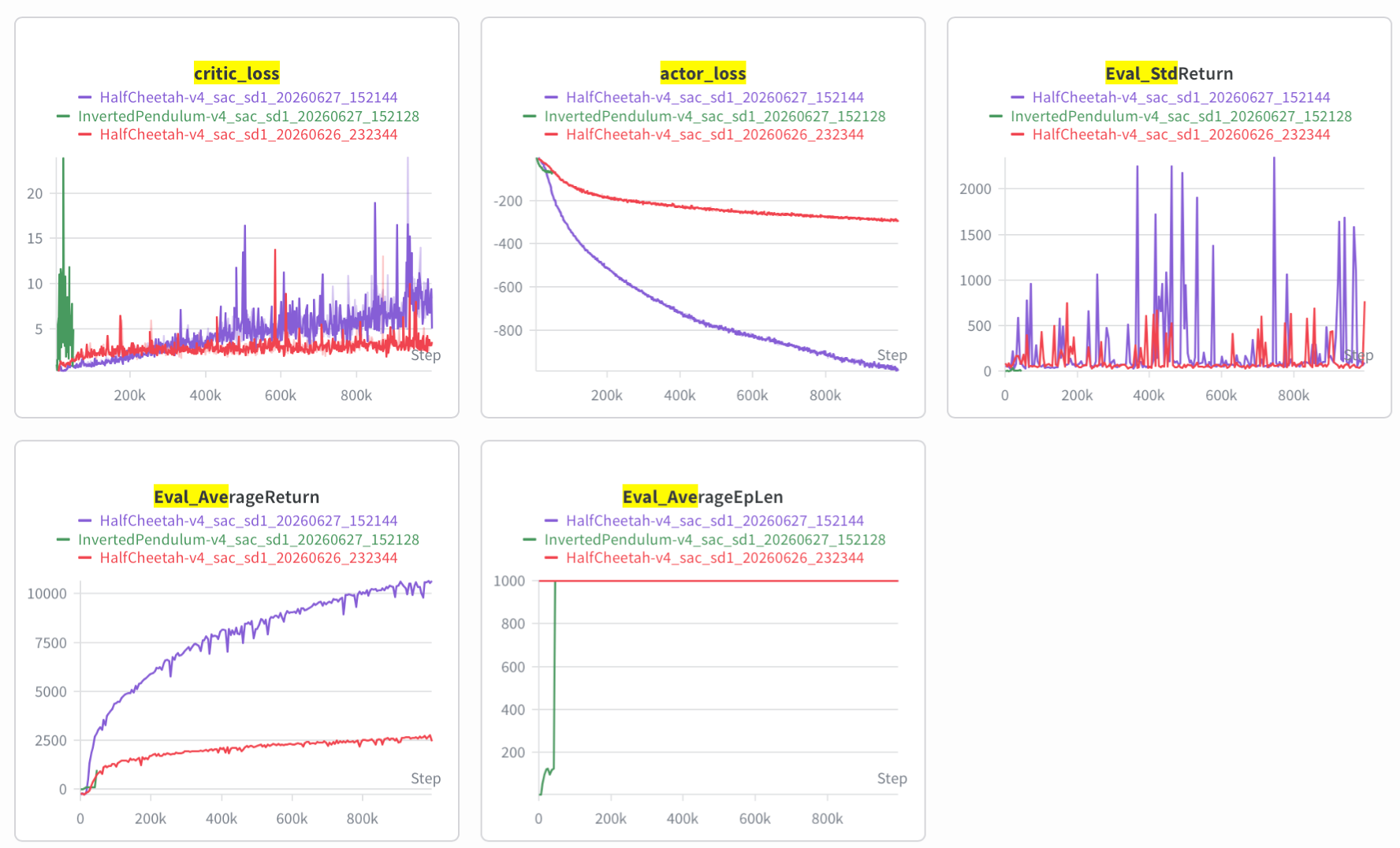
其实此图用了错的代码. 先不更新了.

3.3 用 Entropy 鼓励 policy 的随机性
回忆提纲
- 相比上面几乎只增加了
next_qs += (self.temperature * next_action_entropy).unsqueeze(0) # (num_critics, b)- 此处如何利用 action distribution 计算 entropy? 是从 dist 中采样一个 action 然后算 -dist.log_prob(action),十分暴力. 为啥能这样呢?首先 entropy 的定义是
H = E[ -log pi(a | s) ],比如动作分布为 0.1, 0.9 比 0.5, 0.5 的熵略高. 虽然对于 Gaussian Policy,输出的 action dist 可以直接计算 H,但是代码中还支持 use_tanh,此时无法直接 dist.entropy().
- 此处如何利用 action distribution 计算 entropy? 是从 dist 中采样一个 action 然后算 -dist.log_prob(action),十分暴力. 为啥能这样呢?首先 entropy 的定义是
回答问题
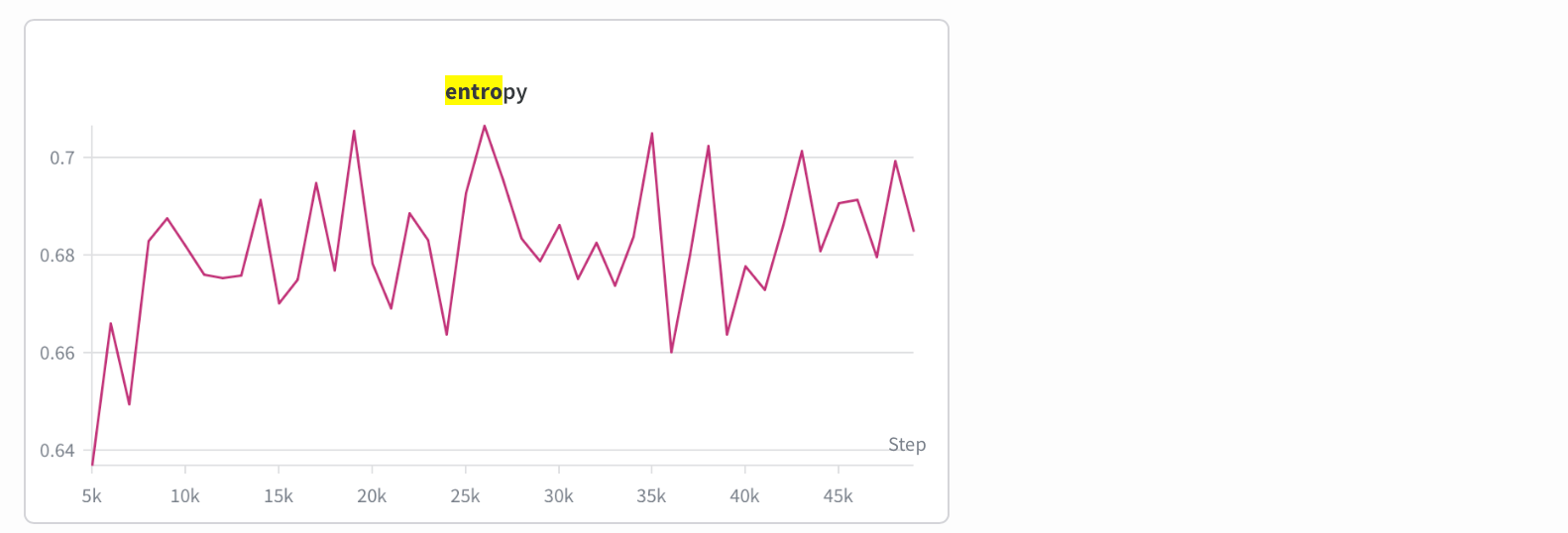
For a tanh-squashed 1D action space, this is approximately log 2 ≈0.69.
3.4 Actor Update with Reparametrization
回忆提纲
1actor_loss = -online_critic(actor(obs).rsample()) - entropy * temperature2# 注:优化器仅带 actor 参数所以 critic 不用冻结.3# rsample() 就可以正确传播梯度,sample() 则不行.回答问题
• Train on HalfCheetah-v4 with halfcheetah.yaml. Plot results with number of environment steps on
the x-axis and evaluation return on the y-axis. You should expect to achieve a return of at least 6000
at least once during training.
uv run src/scripts/run_sac.py -cfg experiments/sac/halfcheetah.yaml
3.5 Autotune Temperature
回忆提纲
本节目标是让 action distribution entropy 大于等于定值,同时最大化奖励,因此使用 Dual gradient descent
回答问题
• Run auto-tuned SAC on HalfCheetah-v4: uv run src/scripts/run_sac.py -cfg experiments/sac/halfcheetah_autotune.yaml
• Create a figure with two subplots: – Eval return over training for both fixed temperature (from Section 3.4) and auto-tuned temperature – Temperature value (α) over training for the auto-tuned run
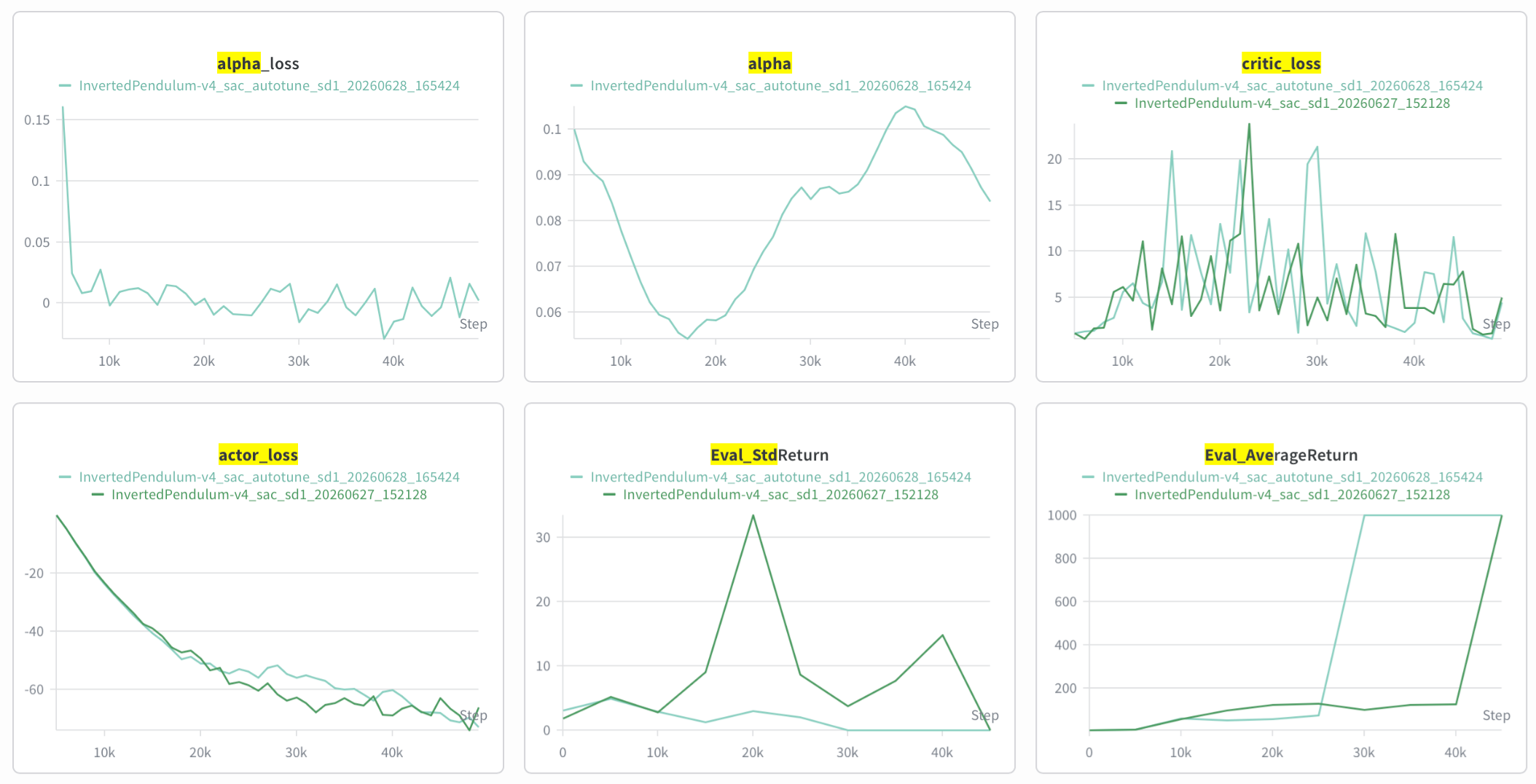 temperature 来回变化,ave return 更早突破 1000.
• Answer the following questions: – Does auto-tuning improve or achieve comparable performance to the fixed temperature? – How does the temperature evolve during training? Does it increase, decrease, or s
纠错过程
- 一开始 loss -= entropy 这里忘记了
* temperature,最终奖励仅到 2500 左右,如上图红色部分. - log_alpha 相关搞错了很多地方,既然变量名为 log_alpha 那么取 temperature 自然需要 log_alpha.exp(),老是忘 exp()
- 讲义 ∇_α J(α) = E(-alpha * C) 这个公式似乎有问题,应该是 J = E(-alpha * C), 其对 log_alpha 求导仍然是 E(-alpha * C).
3.6 悲观估计 clipped double-Q
回忆提纲
仅需改一行. next_qs = next_qs.mean(dim=0) -> next_qs = next_qs.min(dim=0).values. 使用多个 Q,对 actor 的输出进行估值时直接取 min.
回答问题
• Run single-Q and clipped double-Q on Hopper-v4 using the corresponding configuration files. You should expect the clipped double-Q to achieve a return of at least 1500 at least once during training. Which one works best? Plot the logged eval return from each of them as well as q values. Discuss how these results relate to overestimation bias.
1uv run src/scripts/run_sac.py -cfg experiments/sac/hopper_singleq.yaml2uv run src/scripts/run_sac.py -cfg experiments/sac/hopper_clipq.yaml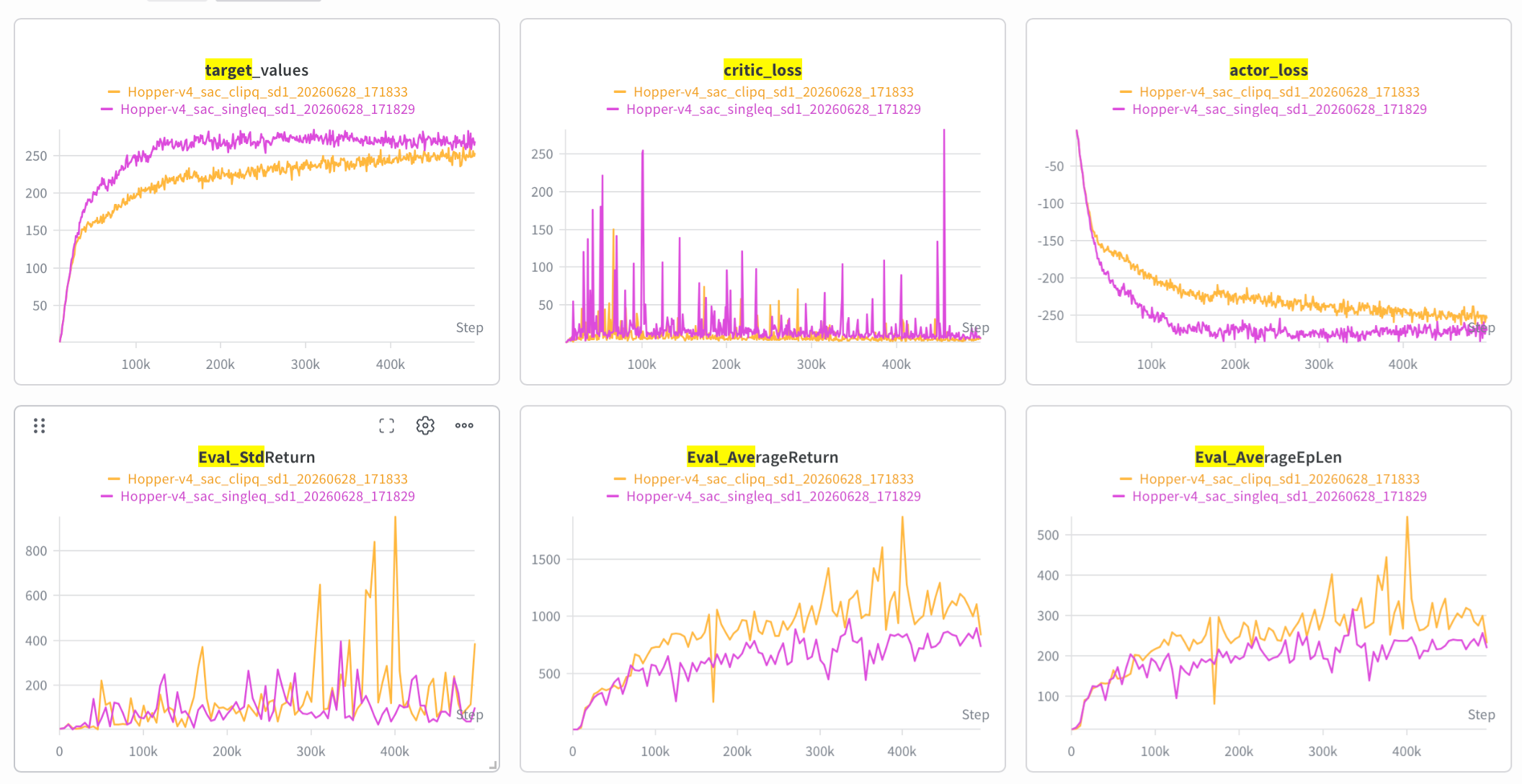
使用悲观估计 q values 确实更小了, avg_return 和 std_return 更稳定.
附录
如何使用其他目录的环境运行当前目录:
1cd hw32source ../hw2/.venv/bin/activate.fish3PYTHONPATH=src uv run --active \4 src/scripts/run_dqn.py -cfg experiments/dqn/lunarlander.yaml